NATIONAL
CALIFORNIA
VENTURA
policies
mechanism
Inhibits calcium ion from entering the “slow channels” or select voltage-sensitive areas of vascular smooth muscle and myocardium during depolarization; produces relaxation of coronary vascular smooth muscle and coronary vasodilation; increases myocardial oxygen delivery in patients with vasospastic angina.
indications
Oral: Hypertension, chronic stable angina, vasospastic angina
contraindications
Oral: Hypersensitivity to diltiazem or any component of the formulation; sick sinus syndrome (except in patients with a functioning artificial pacemaker); second- or third-degree AV block (except in patients with a functioning artificial pacemaker); hypotension (systolic <90 mm Hg); acute MI and pulmonary congestion
dosing
Dosing: Adult
Note : Avoid in patients taking a beta-blocker or who have heart failure with reduced ejection fraction, sinus node dysfunction, or second- or third-degree atrioventricular block unless a functioning pacemaker has been placed. Angina pectoris Angina pectoris:
Chronic stable angina (alternative agent): Note: A beta-blocker is the preferred initial therapy; if there are ongoing symptoms on beta-blocker therapy, a calcium channel blocker (typically a dihydropyridine [eg, amlodipine]) may be added with close monitoring of heart rate; diltiazem may be used as an alternative therapy if there are contraindications or unacceptable adverse effects with beta-blockade (Ref ).
Immediate release: Oral: Initial: 30 mg 4 times daily; increase as needed at 1- to 2-day intervals to effective antianginal dose; usual effective dose: 240 to 360 mg/day in 3 to 4 divided doses (Ref ).
12-hour (twice-daily) formulations (off label): Oral: Initial: 60 mg twice daily; increase as needed at 7- to 14-day intervals to effective antianginal dose; usual effective dose: 240 to 360 mg/day in 2 divided doses (Ref ).
24-hour (once-daily) formulations: Oral: Initial 120 to 180 mg once daily; increase as needed at 7- to 14-day intervals to effective antianginal dose; usual effective dose: 240 to 360 mg/day (Ref ).
Vasospastic angina: Note: May use alone or in combination with nitrates (Ref ).
Immediate release: Oral: Initial: 30 mg 4 times daily; increase as needed at 1- to 2-day intervals to effective antianginal dose; usual effective dose: 240 to 360 mg/day in 3 to 4 divided doses.
12-hour (twice-daily) formulations (off label): Oral: Initial: 60 mg twice daily; increase as needed at 7- to 14-day intervals to effective antianginal dose; usual effective dose: 240 to 360 mg/day in 2 divided doses (Ref ).
24-hour (once-daily) formulations: Oral: Initial: 120 to 180 mg once daily; increase as needed at 7- to 14-day intervals to effective antianginal dose; usual effective dose: 240 to 360 mg/day (Ref ).
Chest pain associated with cocaine ingestion, with or without evidence of acute coronary syndrome (off-label use) : Note: Adjunct or alternative to nitroglycerin.
IV: Bolus: Initial: 0.25 mg/kg (actual body weight) over 2 minutes (average dose: 20 mg); may repeat after 15 minutes if needed (Ref ). Atrial fibrillation or atrial flutter, rate control Atrial fibrillation or atrial flutter, rate control: Note: For rate control in hemodynamically stable patients. Do not use in patients with preexcitation associated with an accessory pathway, as this can lead to ventricular arrhythmias (Ref ).
Acute ventricular rate control:
IV: Bolus dose: 0.25 mg/kg (actual body weight) over 2 minutes (average dose: 20 mg); if rate control is insufficient after 15 minutes, a repeat bolus dose of 0.35 mg/kg over 2 minutes may be given (average dose: 25 mg). Patients who respond after 1 or 2 bolus doses can be started on a continuous infusion.
IV: Continuous infusion following bolus(es): Initial: 5 to 10 mg/hour; infusion rate may be increased in 5 mg/hour increments according to ventricular response, up to a maximum of 15 mg/hour. Note: When increasing the infusion rate, an additional bolus dose can be used to provide more immediate onset (Ref ). In general, the use of a continuous infusion >24 hours or >15 mg/hour is not recommended due to potential for drug accumulation. See conversion section below to switch from IV infusion to oral.
Chronic ventricular rate control (off-label use):
Immediate release: Oral: Initial: 30 mg 4 times daily; increase as needed to achieve ventricular rate control; usual dose: 120 to 480 mg/day in 3 or 4 divided doses (Ref ).
Extended release: Oral: Initial: 120 mg once daily or in 2 divided doses depending on formulation; increase as needed to achieve ventricular rate control; usual dose: 120 to 480 mg/day (Ref ). Hypertension Hypertension (alternative agent): Note : Reserve nondihydropyridine calcium channel blockers for patients with a relevant comorbidity (eg, rate control in atrial fibrillation or flutter) (Ref ). For patients who warrant combination therapy (BP >20/10 mm Hg above goal or suboptimal response to initial monotherapy), may use in combination with another appropriate agent (eg, angiotensin-converting enzyme inhibitor, angiotensin II receptor blocker, thiazide diuretic) (Ref ).
12-hour (twice-daily) formulations: Oral: Initial: 60 to 120 mg twice daily; increase dose as needed after ~7 to 14 days; usual dose: 240 to 360 mg/day in 2 divided doses.
24-hour (once-daily) formulations: Oral: Initial: 120 to 240 mg once daily; increase dose as needed after ~7 to 14 days; usual dose: 120 to 360 mg once daily (Ref ). Nonsustained ventricular tachycardia or ventricular premature beats, symptomatic Nonsustained ventricular tachycardia or ventricular premature beats, symptomatic (alternative agent) (off-label use): Note: A beta-blocker is the preferred initial therapy; if there are ongoing symptoms on beta-blocker therapy, diltiazem may be added with close monitoring of heart rate; diltiazem may be used as an alternative therapy if beta-blockade cannot be tolerated (Ref ).
Oral: Initial: 120 to 180 mg once daily or in divided doses depending on the drug formulation; usual effective dose: 240 to 360 mg/day; maximum dose: 480 mg/day (Ref ). Pulmonary arterial hypertension, group 1 Pulmonary arterial hypertension, group 1 (alternative agent) (off-label use): Note: Only used for group 1 pulmonary arterial hypertension patients with a positive vasoreactivity test and under the care of a pulmonary hypertension specialist (Ref ).
12-hour (twice-daily) formulations: Oral: Initial: 60 mg every 12 hours; titrate gradually, with close hemodynamic monitoring; reported daily dose range: 120 to 720 mg/day in 2 divided doses (Ref ).
24-hour (once-daily) formulations: Oral: Initial: 120 mg once daily; titrate gradually, with close hemodynamic monitoring; reported daily dose range: 120 to 720 mg/day (Ref ). Supraventricular tachycardia Supraventricular tachycardia (eg, atrioventricular nodal reentrant tachycardia, atrioventricular reentrant tachycardia, focal atrial tachycardia, multifocal atrial tachycardia) (alternative agent): Note: For hemodynamically stable patients if vagal maneuvers and/or adenosine are unsuccessful. Do not use in patients with preexcitation associated with an accessory pathway, as this can lead to ventricular arrhythmias (Ref ).
Acute treatment:
IV: Bolus dose: 0.25 mg/kg (actual body weight) over 2 minutes (average dose: 20 mg); if response is insufficient after ≥15 minutes, a repeat bolus dose of 0.35 mg/kg over 2 minutes may be given (average dose: 25 mg). If bolus(es) do not terminate the arrhythmia, consider alternative therapy.
Chronic maintenance (off-label use):
Immediate release: Oral: Initial: 30 mg 4 times daily; increase as needed for heart rate control; usual effective dose: 360 mg/day in divided doses (Ref ).
Extended release: Oral: Initial: 120 mg once daily or in 2 divided doses depending on formulation; increase as needed for heart rate control; usual effective dose: 360 mg/day (Ref ).
Conversion between dosage forms:
Conversion from immediate-release to extended-release formulations: Patients stabilized on a maintenance regimen between 120 and 360 mg of immediate-release tablets may be switched to an extended-release formulation at the same daily dose administered in 1 or 2 divided doses depending on formulation. In some patients, the dosage of the extended-release formulation may require adjustment following conversion.
Conversion from IV infusion to oral: Immediate release can be started ~1 hour before stopping infusion. Oral daily dose may be estimated from the IV infusion rate by using the equation below. Round oral doses to the nearest appropriate strength and formulation.
Oral dose (mg per day) = [infusion rate (mg/hour) × 3 + 3] × 10
5 mg/hour = 180 mg/day.
10 mg/hour = 300 to 360 mg/day.
15 mg/hour = 480 mg/day.
Dosage adjustment for concomitant therapy: Significant drug interactions exist, requiring dose/frequency adjustment or avoidance. Consult drug interactions database for more information.
administration
Oral:
onset
Oral
peak
1 week to 5 months
duration
IV: Bolus: 1 to 3 hours; Continuous infusion (after discontinuation): 0.5 to 10 hours
dosage form
pregnancy class
adverse reactions
Adverse Reactions
The following adverse drug reactions and incidences are derived from product labeling unless otherwise specified. Incidences represent ranges for various dosage forms. Patients with impaired ventricular function and/or conduction abnormalities may have higher incidence of adverse reactions.
>10%: Cardiovascular: Peripheral edema (5% to 15%; dose-related)
1% to 10%:
Cardiovascular: Bradycardia (3% to 4%), bundle branch block (<2%), cardiac arrhythmia (1%), cardiac failure (<2%), complete atrioventricular block (<2%), ECG abnormality (<2%), edema (2% to 3%), extrasystoles (2%), first-degree atrioventricular block (3% to 4%), hypotension (3% to 4%), lower extremity edema (5% to 8%), palpitations (1% to 2%), second degree atrioventricular block (<2%), syncope (<2%), vasodilation (2% to 3%)
Dermatologic: Pruritus (<2%), skin photosensitivity (<2%) (Ramirez 2007), skin rash (1% to 2%) (Tuchinda 2014) (table 1) Diltiazem: Adverse Reaction: Skin Rash Diltiazem: Adverse Reaction: Skin Rash
Drug (Diltiazem)
Placebo
Dose
Number of Patients (Diltiazem)
Number of Patients (Placebo)
2%
0%
540 mg
49
50
1%
0%
Up to 360 mg
158
50
Endocrine & metabolic: Albuminuria (<2%), gout (1% to 2%), gynecomastia (<2%), hyperglycemia (<2%), hyperuricemia (<2%), increased lactate dehydrogenase (<2%), increased thirst (<2%), weight gain (<2%)
Gastrointestinal: Abdominal swelling (2%), anorexia (<2%), constipation (<2%), diarrhea (1% to 2%), dysgeusia (<2%), dyspepsia (1% to 6%), nausea (2%), vomiting (<2%), xerostomia (<2%)
Genitourinary: Crystalluria (<2%), impotence (2%), nocturia (<2%), sexual difficulty (<2%)
Hematologic & oncologic: Petechia (<2%)
Hepatic: Increased serum alanine aminotransferase (<2%), increased serum alkaline phosphatase (<2%), increased serum aspartate transaminase (<2%)
Hypersensitivity: Hypersensitivity reaction (<2%)
Infection: Infection (1% to 6%)
Local: Burning sensation at injection site (≤4%), itching at injection site (≤4%)
Nervous system: Abnormal dreams (<2%), abnormal gait (<2%), amnesia (<2%), depression (<2%), dizziness (2% to 10%), drowsiness (<2%), fatigue (5%), hallucination (<2%), headache (2% to 8%), insomnia (<2%), nervousness (2%), pain (6%), paresthesia (<2%), personality changes (<2%)
Neuromuscular & skeletal: Asthenia (1% to 4%), increased creatine phosphokinase in blood specimen (<2%), muscle cramps (<2%), myalgia (2%), neck stiffness (<2%), osteoarthritis (<2%), tremor (<2%)
Ophthalmic: Amblyopia (<2%), conjunctivitis (2%), eye irritation (<2%)
Otic: Tinnitus (<2%)
Renal: Polyuria (<2%)
Respiratory: Bronchitis (1% to 4%), cough (1% to 2%), dyspnea (1% to 6%), epistaxis (<2%), flu-like symptoms (2%), paranasal sinus congestion (1% to 2%), pharyngitis (6%), rhinitis (<2%)
<1%:
Cardiovascular: Atrial flutter, sinus node dysfunction, ventricular fibrillation, ventricular tachycardia
Dermatologic: Urticaria
Frequency not defined: Hepatic: Hepatic injury (Deng 2013; Shallcross 1987), increased serum bilirubin
Postmarketing:
Cardiovascular: Asystole (Moser 1996; Subahi 2018), hypersensitivity angiitis, vasculitis (Sheehan-Dare 1988)
Dermatologic: Acute generalized exanthematous pustulosis (rare: <1%) (Gesierich 2006; Knowles 1998; Saenz de Santa Maria Garcia 2016; Vicente-Calleja 1997), alopecia, cutaneous lupus erythematosus (Crowson 1995; Srivastava 2003), erythema multiforme (Stern 1989; Wittal 1992), exfoliative dermatitis (Odeh 1997; Sousa-Basto 1993), maculopapular rash (Cholez 2003; Gonzalo Garijo 2005), psoriasis (Song 2021), Stevens-Johnson syndrome (rare: <1%) (Sanders 1993; Taylor 1990), toxic epidermal necrolysis (rare: <1%)
Gastrointestinal: Gingival hyperplasia (Bowman 1988; Steele 1994)
Hematologic & oncologic: Hemolytic anemia, leukopenia, prolonged bleeding time, purpuric disease (Inui 2001), thrombocytopenia (Michalets 1997)
Hypersensitivity: Angioedema
Nervous system: Extrapyramidal reaction
Neuromuscular & skeletal: Myopathy (Ahmad 1993)
Ophthalmic: Periorbital edema (Friedland 1993), retinopathy
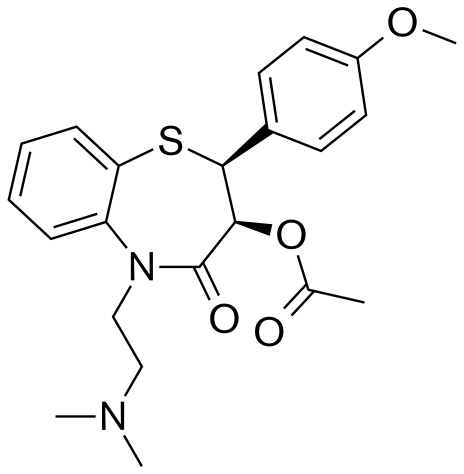
structure
warnings
Warnings/Precautions
Concerns related to adverse effects:
• Hepatic effects: Mild elevations of transaminases with and without concomitant elevation in alkaline phosphatase and bilirubin have been observed and frequently resolve spontaneously. Significant elevations in hepatic transaminases (eg, alkaline phosphatase, LDH, AST, ALT) and signs of acute hepatic injury have also been observed 1 to 8 weeks after therapy initiation and have been reversible upon discontinuation.
• Hypotension/syncope: Symptomatic hypotension with or without syncope can rarely occur; blood pressure must be lowered at a rate appropriate for the patient's clinical condition.
Disease-related concerns:
• Accessory bypass tract (eg, Wolff-Parkinson-White [WPW] syndrome): During an episode of atrial fibrillation or flutter in patients with an accessory bypass tract or preexcitation syndrome, use has been associated with increased anterograde conduction down the accessory pathway leading to ventricular fibrillation; avoid use in such patients (ACLS [Neumar 2010]; AHA/ACC/HRS [January 2014]).
• Hepatic impairment: Use with caution in patients with hepatic impairment.
• Left ventricular dysfunction: Use with caution in left ventricular dysfunction; due to negative inotropic effects, may exacerbate condition. Avoid use in patients with heart failure due to lack of benefit and/or worse outcomes with calcium channel blockers in general (AHA/ACC/HFSA [Heidenreich 2022]).
• Renal impairment: Use with caution in patients with renal impairment.
Other warnings/precautions:
• Appropriate use: IV: Unless otherwise contraindicated, appropriate vagal maneuvers should be attempted prior to administration of IV diltiazem. Use with caution in patients hemodynamically compromised; continuously monitor ECG and blood pressure during administration (especially during continuous IV infusion). Initial use should be, if possible, in a setting where monitoring and resuscitation equipment, including DC cardioversion/defibrillation, are present.